About Me My Classroom Freebies Collaboration Image Map
Showing posts with label Nonfiction. Show all posts

Thursday, April 16, 2015

Wax Museum - Non-Fiction Unit Presentation

We finished our non-fiction reading unit, so the students shared what they learned by presenting in a wax museum.  This is something people have been doing forever, but I just thought it was so cute.  My students really got into it.  They wore their outfits all day and we had to refer to them as their character name.  It was very impressive to see how hard they worked and to see how much they learned.  The students were so well prepared that many spoke as if they were the actual person and shared a lot of information about him/her.   Check out our pictures below!


Ferdinand Magellan 

Harry Houdini

Neil Armstrong

Anne Frank

Jane Goodall

Thomas Edison

Walt Disney

Jackie Robinson

Babe Ruth


Then, we had other students in our school visit.  Each person was given 3 tickets to attend 3 different exhibits.  When they handed the ticket to one of the presenters, then the presenter would unfreeze and begin talking.  The kids loved being "frozen!"


Saturday, April 11, 2015

Non-Fiction Book Clubs - Week 5

It is the final week of our non-fiction book club unit.  The kids have learned so much about reading non-fiction books and how to share what they learn.

This week, the students finished the second biography they were reading.  So, now they have read two different biographies on the same topic. This is so important for students to understand that they should read several articles or sources about the same topic to become experts on the topic.  

I started by discussing with the class why we compare two books on the same topic.  The students helped me create the anchor chart.  This helps me see what they have learned, as well as fully understand what we're doing.  When the students can explain in their own words, then I feel that the lesson has been successful.  


Then, we made a chart that allowed us to share what we learned from book topics and how they shared the same information.  Then, we shared why the author wrote this in both books.  We have learned that a fact that is shared in both books must be very important.  Students were given a recording sheet where they wrote about the two biographies they read.  The recording sheet matched the chart below. 


Once we compared the two books, we then focused on writing summaries of the non-fiction text we read.  So, we compared non-fiction summaries to fiction summaries.  


Then, we wrote out how we should write a non-fiction summary to help the kids stay on task when writing their summary.


You can find my non-fiction summary rubric here and my fiction summary rubric here if you are interested! 

You can get my non-fiction reading unit by clicking on the picture below!


Thanks for checking out my non-fiction reading unit!  Be sure to check out how my students shared what they learned by visiting my blog post about our Wax Museum! 

Friday, April 10, 2015

Non-Fiction Book Clubs Week 4

Week 4 sped by!  We had so much fun analyzing the character in our non-fiction biography book.  The students completed their first biography book about the person, and they started on the second book.  When reading non-fiction, I teach my students to read several sources on the same topic so they can become experts on what they're studying.  You will learn more about this during week 5.

As I said, we focused on the character in the book.  The main character is obviously who the book is about.  So, we wanted to focus on the character's traits and better understand the person we are reading about.

So, we made a web to share character traits about the person.  Then, off the character traits we explained what part of the book supports this trait.  For example, when reading about Ronald Reagan we said he was brave because the book told us that he saved 77 people from drowning when he was a lifeguard.  Wow!  That was very impressive and very brave.  


I modeled using Ronald Reagan, since that was the book we read together as a class.  Then, each group created their own webs using large bulletin board paper and markers.


I have all of these activities in my non-fiction reading book club unit.  I just enjoy using different materials occasionally.  My kids also really enjoy it!


Then, each group shared what they learned about their person.  I loved how they were able to share the character traits of the person and explain why they thought that.  This helped with my students finding text evidence to support their answers. 


You can check out my reading workshop unit by clicking on the picture below!


You can find week 5 by clicking here!


Thursday, April 9, 2015

Non-Fiction Reading Clubs - Week 3

Week 3 of our non-fiction reading book club unit is complete!  During this week, we focused on what we should do when we don't understand the book.  Well, there are many things students can do, but do they do it- no! :/  So, I am working on encouraging my students to be more independent when trying to solve problems.  They often just skip over the part and don't even try to understand it or they  immediately ask someone else for help.  Don't get me wrong, I am all for helping my kids when they are struggling.  However, I also want them to learn how to attempt it on their own because when they are testing - I won't be able to help them.

So, we created a list of things we can do when we don't understand something.  We have learned how to use all of these things throughout the year, but it is always a good reminder for the students.  I also liked having all their resources listed in one place so they can reference it.  

I also stressed for them to not spend more than 2-3 minutes on figuring it out.  I don't want them to get frustrated or spend the whole reading block finding one simple answer.  If they cannot solve it within 2-3 minutes, then they must ask someone for help.

I also feel that it is important that the students focus on things that are important, not small words or phrases that might not mean much to the whole story.

Check out my not-so fancy anchor chart below!


Once we learned how to answer our own questions, we focused on finding the main idea of the text.  When reading a chapter book, it is important that students can find the main idea of each chapter.  This will help them remember and understand what they read.  

So, when finding the main idea we must:

1. look at the title
2. look for details
3. look at the pictures
4. look at the introduction/table of contents
5. think about the characters in the story

The main idea must also have the who and the what!


You can find the activity and worksheets in my non-fiction reading book club unit below!


Check out week 4 by clicking here!


Wednesday, April 8, 2015

Non-Fiction Reading Clubs Week 2

Here is week 2 of our non-fiction reading book club unit.  The students are about halfway through their biography, and I felt that this was a good place for students to start thinking about why the author shares certain information with the reader.  When reading, we must always be thinking and wonder why an author teaches us certain things.  When reading biographies, we learn that there could be many things shared about the person.  However, the author chooses to focus on certain parts of the person's life.  As readers, we must wonder what was the author's purpose and what was the author wanting us to learn.

So, we had a great discussion about why authors teach us certain things.  The students help me create the anchor charts.  I create new charts each year because I want student input.  Once we discussed why authors teach us certain things, then we focused on finding important topics in the book the author taught us and then think about why the author wrote this in the book.  We want to always be thinking while we read, and it is important to think about the author and why he/she would share specific information.  Does our opinion about the person change?  Do we learn more about the person?  We must understand the purpose.


I modeled how to find things the author shared in the story and then explain why he/she shared it.  As a class, we read the biography of Ronald Reagan.  This is what I used to model and had the students help me.


Then, the students created their own charts using large bulletin board paper.  They LOVED using markers and having the big paper to write on!


Each group was given a sheet to record, and then the students shared their information with the class. 


I loved how hard they worked!


You can find these as printables in the Nonfiction Reading Book Club unit by clicking on the picture below. 


Check out week 3 by clicking here!


Tuesday, April 7, 2015

Non-Fiction Reading Clubs Week 1

I wrote several blog posts about my fiction reading book clubs.  Now, it is time for my non-fiction reading book clubs!

I loved the reading fiction book club, but the non-fiction unit might be my favorite.  It turned out really well and the kids learned so much.

We focused on biographies for our non-fiction reading.  I had my students split into 3 groups.  I let the students pick the biography they wanted to read.  I had a whole set of books from Scholastic - the Who was, Who is biography set.  One group chose Thomas Edison, the second group chose Jane Goodall, and the third group chose Anne Frank.  

Each student was given a non-fiction reading journal to record their responses in.  The journal reflected the mini lesson for the day.  The unit I created has daily learning targets with objective checks for each target.

In December, the unit focused on how to read non-fiction text.  You can read about that unit here.  So, this unit is focusing more on how to share what we've learned from non-fiction text.  Isn't our main goal as readers to understand what we read and then share our knowledge with others?

I focused on how to find important parts in non-fiction text to share.  This can be pretty tricky for my little ones because they want to share every details or things that are not important.  

I like to make lists so that my students can follow the criteria easier.  We also discussed that in order for a part in the story to be important, the reader must be able to state why and how it helped them understand.  If they can do that, then I will accept it as an important part of the book!


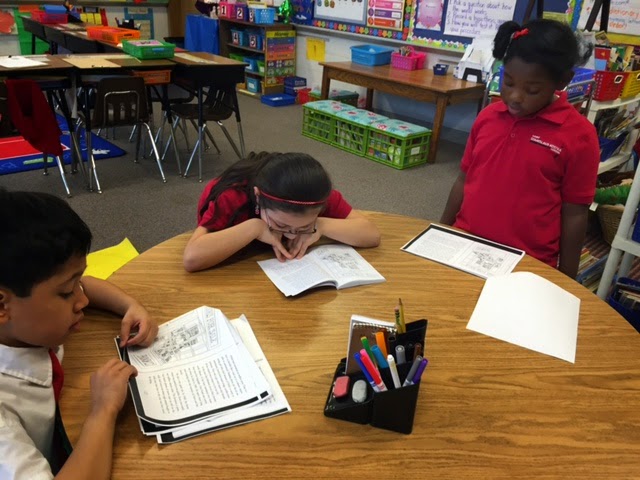
You can check out my kiddos in their small groups.  I rotate among the groups to encourage group discussion and to show that I'm available if they have any questions. 


We also focused on retelling what we read.  This helps with comprehension.  I created a bookmark for the kids to use when reading.  They can reference it after they read a passage, page, or chapter.  It reminds them to pause and retell what they learned in their own words.  It also includes some questions they can ask their group members to help them build discussion.  


Here is one of my students politely waiting to share with her group members. 


You can find all of these resources by clicking on the picture below.  I have worksheets that go with each learning target to allow students to share what they learned.  I also have just the student journal available separately if you are interested in just that part of the unit.


Check out week 2 of my non-fiction reading book club unit by clicking here.