About Me My Classroom Freebies Collaboration Image Map

Thursday, October 6, 2016

How to Writing with Applesauce

When we learn about apples, I have to squeeze in making applesauce!  It is one of my favorite things to do.  The kids also love eating it. :] 
 

First, I gather all of the materials.  I use a crockpot, about 8 apples, 1/4 cup of water, and some cinnamon.  I cut the apples up and place them in the crockpot.  I let my kids pour in the water and sprinkle the cinnamon on top.  This is a great way to introduce measuring cups and what they mean. 
The kids LOVE pouring in the ingredients.  I was also smart this year because I used a crockpot liner so when we were done I just had to throw the bag away. It made clean up SO much easier. :] 

Once we finish, I use this opportunity to do a how to writing activity.  My kids write how to make applesauce in their little booklet.  


Since this was our first time writing like this, I made the steps very simple and easy to follow.  I didn't want to overwhelm them with a lot of writing. 


You can see how they wrote and matched the words to the pictures. 


One of my kiddos messed up the order of his booklet, so we did a little problem solving by crossing out the numbers and rearranging the pages. :] No need for stress and tears! 

When we were all done - it took the applesauce about 4 hours on high to cook - we enjoyed our treat! When I poured them into the bowls, I let them sit for a little bit so my kiddos didn't burn their tongues. :] 

If you want to grab this booklet we used - you can click on the image below.  It is FREE. :]


Wednesday, October 5, 2016

Exploding Apples Experiment


This experiment was SO much fun!!  It was also so easy to prepare for.  All you need are apples, a knife, baking soda, vinegar, and cups.  Well, I used the cups so the students could pour in the baking soda and vinegar themselves. They are not absolutely necessary. :]   I also used trays to place the apples on because it can get kind of messy. 

Once you have all the materials, cut the top of the apple out.  I started at the stem and cut a hole in the middle of the apple.  It doesn't have to be very deep.  I cut it about half way.  This allows you to pour the vinegar and baking soda in the apple. 

First, students poured baking soda in one of the apples, and vinegar in the other apple.  We recorded our observations.  We also made a hypothesis before stating whether we thought it would explode more if the vinegar was poured first, then the baking soda OR the baking soda, then the vinegar.

Students, then poured the baking soda on top of the one with vinegar.  They watched it erupt!  Once they recorded their observations, the students poured the vinegar on top of the one with baking soda.  This was a great way to see which one exploded more.  You should have heard my kids giggling and screaming during this experiment.  (I may have screamed a little too. :] )

Here are the pages my students completed to help us follow the scientific method.  We colored the arrow for our hypothesis, and we drew our observations.
Then, we recorded the results and determined whether our hypothesis was correct or not. 

Finally, we drew (or you can write) what you learned as a scientist during the experiment. 

You can find this product by clicking on the image below.  It is only $1! :] 


If you enjoyed this or would like an idea of what this product is like, visit here to learn about our Apple Exposure experiment and grab that one for FREE here. :] 


SaveSave

Tuesday, October 4, 2016

Apple Exposure Experiment


When people think of teachers, they instantly think of apples - or at least I do. :]  When we do fun apple activities, it is one of my favorite times of the year. 

We completed two different apple science experiments during our apple unit.  The first one had to do with oxidation to apples.  This was really interesting, and my kids really enjoyed observing the apples.  They felt like real scientists!

I enjoyed this experiment because it was really easy to prepare for.  The only thing is that you have to allow the apples time to sit (at least 2 hours) in order for the experiment to work. 

First, gather the necessary materials.  You need vinegar, milk, water, lemon juice, apple, cups, and a knife.
Cut the apple into slices and place one slice in each cup.  You will have one cup with vinegar, one with water, one with milk, and one with lemon juice.  You need to pour enough just to cover the apple.  Also, be sure to leave one apple laying on the table - this is the control.


Have students make a hypothesis first as to which item will keep the apple from turning brown.  Then, I let my kids place the apples in the cups.  I try to let them do as much as possible so they feel as if they are completing the experiment on their own.  I also set it up so that there were enough items for the three tables in my classroom.  This way the students weren't fighting over seeing the apples. 

My kids LOVED observing the apples, touching them, and drawing their observations. 

You can see where we recorded our information below. 


This was perfect because it allowed my students to follow the scientific method. 


You can see on the form that we placed the apples in the liquids, and then checked back an hour later. I ended up having to adjust it to 2 hours because the 1 hour wasn't long enough.  Scientists are always adjusting to make their experiment work! :] (At least that's what I told my kids.)


We recorded our final results and wrote what we learned as scientists. 

The kids did a great job being careful with the cups and apples.  We had a lot of fun using our 5 senses to record our observations as well. 

You can find this product in my store for FREE!  Enjoy! :]


Monday, October 3, 2016

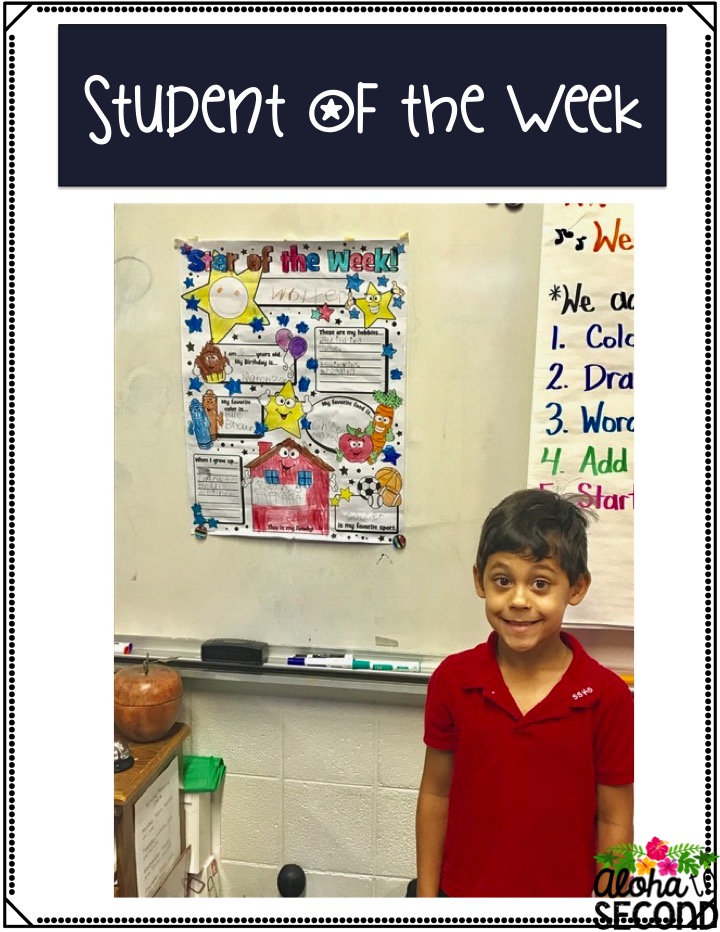
Student of the Week


Each school year I like to focus on one student a week.  I think it is a great way to get to know each student, and it allows me to highlight that student in a positive way.

My students LOVE being the student of the week and look forward to it all year long.
I start by having my student complete the All About Me poster.  I purchase these from Really Good Stuff.  I send it home the Friday before their week so they can complete it over the weekend.  Students share their posters on Monday, and it helps cover our speaking and listening Common Core standards.  I think it is important for student to learn how to present in front of their peers at a young age.  I think it makes it easier as they get older. 

On Tuesday, the student gets to bring in show and tell items.  They LOVE doing this.  I remember doing this when I was little, and I always got so excited to share. 

On Wednesday, I eat lunch with my student of the week.  I really enjoy this because I get to know each student.  We sit at a special table and get to talk one-on-one.  My kids always look forward to this. :]

On Thursday, my student of the week gets to have a special reader.  They often times pick their parents, but sometimes we have grandparents or older siblings in the school.

Finally on Friday we make a poster for our student of the week.  We write down all the reasons why that student is our friend, and we sign it at the bottom.  The student gets to take it home and keep it forever!  I LOVE this part of the week!

I have these forms in my TpT store for only $2!  There are 3 different options and there are also forms included for students to share about current events or book reports.  Click on the image below to check it out. :]


Thanks for stopping by!  I'd also love to hear how you share student of the week in your classroom.  Please leave a comment below. :]